

What is AI Product Engineering?
Everything that makes an AI product work, except the model.

AI product engineering is the work of making an AI feature reliable in production: retrieving the right context, measuring quality with evals, keeping latency low, and closing the loop from real user failures back into fixes. The model supplies raw capability. The engineering layer around it turns that capability into a product people can trust.
TL;DR
The definition: AI product engineering is everything you build around a model to make its output reliable: retrieval, evals, inference tuning, and the feedback loop from production failures.
The problem it solves: raw capability is not a working product, so even a top model ships wrong answers, slow responses, and silent regressions until you engineer the layer around it.
The core skill: error analysis, reading real traces and counting failure types, which Hamel Husain calls the highest-ROI activity in AI development.
Why it matters now: every team rents the same frontier models, so the quality gap between two AI products comes almost entirely from the engineering around them.
The counterintuitive part: a smarter model rarely fixes a broken AI product. The fix is almost always in the context you retrieved or a failure you never measured.
This is the trailer. The full series is AI Product Engineering, taught live by Hamel Husain, the engineer behind the most-taken AI evals course on Maven.
9 free sessions starting June 24.
Why Tweaking the Prompt Stops Working
The first version of almost every AI feature works the same way. You pick a model, write a prompt, paste in some context, and ship. Something comes back wrong, so you tweak the prompt, maybe swap in a bigger model, and ship again. This is prompt engineering, and for a weekend prototype it is exactly right.
It stops working the moment real users arrive. Picture a docs assistant wired to your internal runbooks. A user reports it cited a step you deleted last quarter, so you add a line to the prompt: always check the current runbook. The next week a different user gets a wrong answer about environment variables, and your patch did nothing for it.
Notice what that loop never gives you: a count of how often the assistant is wrong, a way to trace a failure to the step that caused it, or any signal that your last fix helped instead of quietly moving the problem somewhere else.
⚠️ Confusion Alert: Adding more context to the prompt is not the same as fixing retrieval. Stuffing the entire runbook into the prompt raises cost and latency and still buries the one relevant step among forty. Retrieval is the work of finding that single step and leaving the rest behind.
How AI Product Engineering Actually Works
Closing those gaps is the job of the layer around the model, and it comes apart into three jobs plus a loop. Retrieval supplies the right context, evals measure whether the output is any good, and inference and UX shape how fast it arrives. The data loop ties them together, turning every failure into the next improvement. Get any of them wrong and the product breaks.
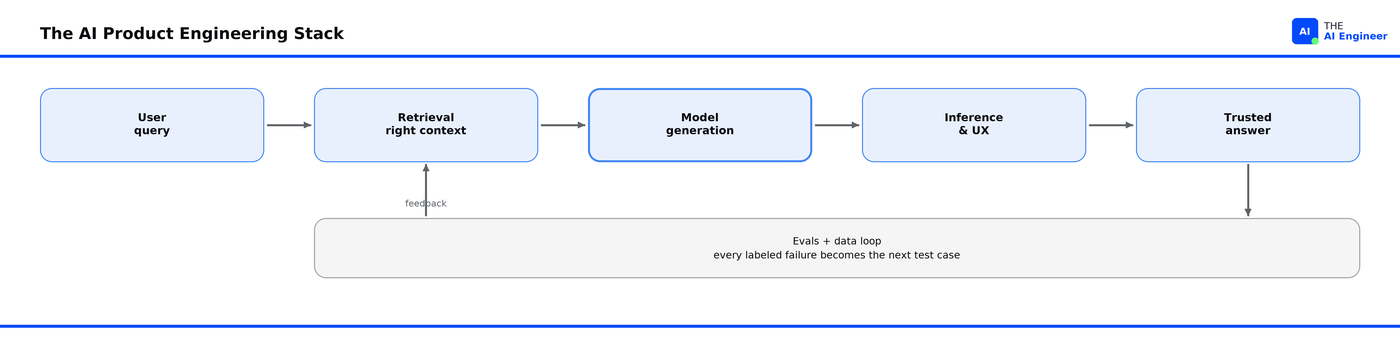
Retrieval feeds the model the right context. That means chunking documents into passages, embedding them into vectors that place similar meanings near each other, and pulling back the closest matches at query time. Hand it the right passage and the answer is grounded in your data. Hand it a plausible wrong one and the model states the mistake with total confidence.
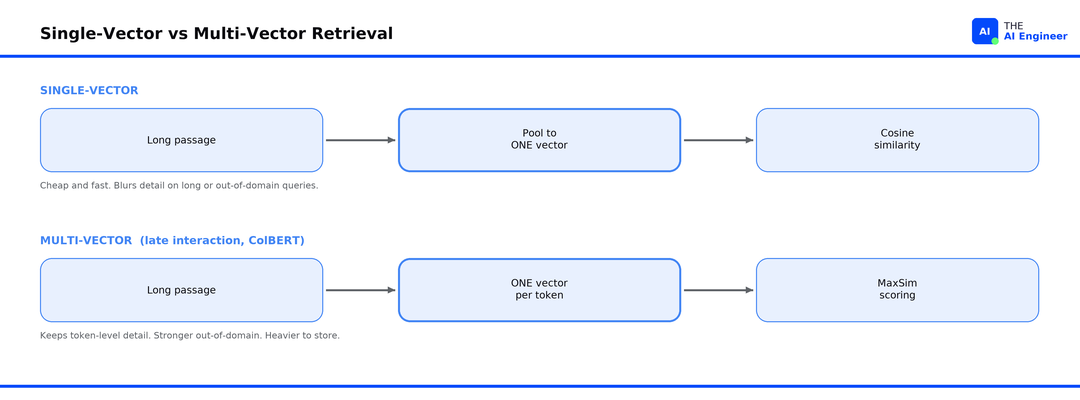
Evals tell you whether a change actually helped. An eval is a repeatable test for output that is not deterministic: you pin down a set of real inputs, write what a good answer looks like for each, and score every prompt or model change against it. Below it sits error analysis, the hands-on half no tool can do for you. You read real traces, label what broke in each, and count the categories, so the failure that happens most often is the one you fix first.
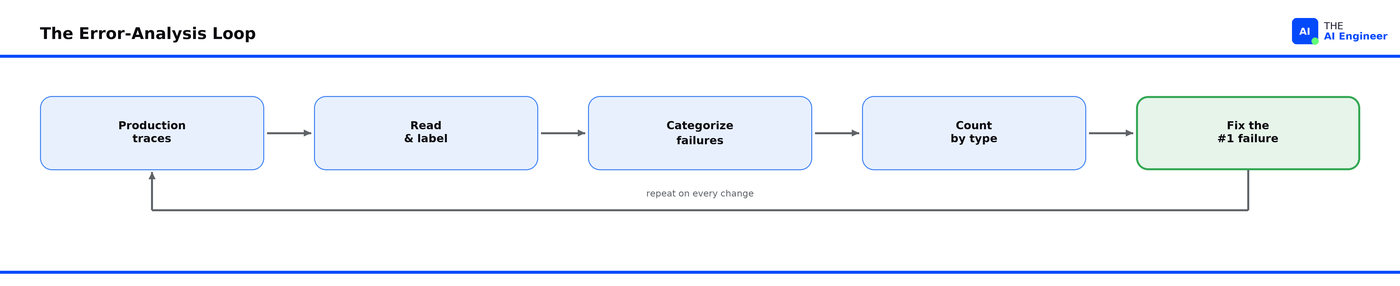
Hamel Husain calls error analysis the single highest-ROI activity in AI development, and the step most teams skip. Teams that build a real trace viewer iterate about ten times faster than teams working from raw logs1.
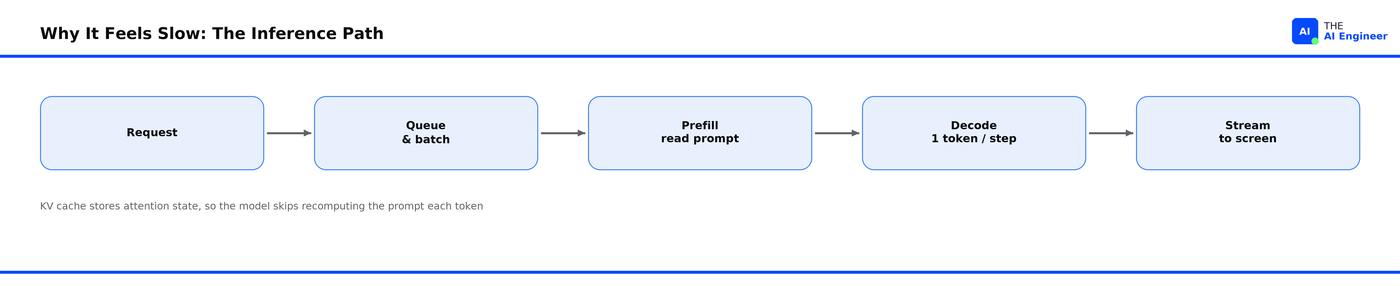
Inference and UX decide whether it feels fast. A capable model still feels sluggish if the serving path is wrong. Latency hides in how requests batch, in the split between prefill (reading your prompt) and decode (writing the answer one token at a time), and in the KV cache that stores attention state so the model skips recomputing the prompt on every token. The highest-leverage UX move is streaming: pushing tokens to the screen as they generate drops the wait the user feels from full-response latency down to time-to-first-token, so the user starts reading within a second even though the total compute has not changed. We covered the mechanics in Why Is Inference Slow and Expensive?.
The data loop is what makes the other three compound. Every failure you label is worth keeping twice. Once as an eval case, so the same bug trips an alarm the moment it returns, and once as a labeled example you can feed into a sharper prompt or a fine-tune. Teams that run this loop watch their failure list shrink week over week. Teams that skip it re-debug the same handful of issues every release, because nothing they learned got written down anywhere the system can reuse.
Who’s Actually Building This Way
You can see the whole discipline in three production stories: one team that built the full layer, one that fixed a product with evals alone, and one that shipped without the layer and had to walk it back.
DoorDash built the full layer. Their Dasher support assistant runs on retrieval, and at first RAG alone broke in a telling way: when the retrieved context was ambiguous, the model fell back on its training data and invented refund policies and insurance products that do not exist. So they wrapped it. An LLM guardrail validates every response in real time, and an LLM judge scores quality continuously. Together those cut hallucinations by 90% and severe compliance mistakes by 99%, on a system fielding thousands of support requests a day2. We pulled apart that architecture in How DoorDash Built Their RAG System.
Nurture Boss fixed a product with evals alone. Their assistant kept mishandling dates, and instead of reaching for a bigger model, the team read the traces, found that most failures clustered in one category, and fixed that category. Date-handling success climbed from 33% to 95%, same model, error analysis only3.
Klarna shows the bill for skipping the layer. Klarna pushed an AI assistant to two-thirds of its support chats, 2.3 million conversations in the first month, work it pegged at 700 agents. Quality slipped, and by 2025 it had started hiring humans back, with the CEO admitting the rollout had traded too much quality for cost. Ship at that scale with no measurement loop and your customers run the error analysis for you, in public4.
What’s Overhyped, and What’s Actually Hard
Three things in this space get oversold.
Reaching for a bigger model is the reflex when a feature misbehaves, and it almost never helps, because the failure usually lives in the context you retrieved rather than the weights. A smarter model just delivers the same wrong answer more fluently.
RAG gets sold as a switch you flip. Bolting a vector search onto a model takes an afternoon. Getting it to surface the one passage that matters on a messy, out-of-domain query is the part that eats months, and it is where most “we added RAG” features quietly stall.
The self-grading LLM judge is the subtlest trap. Asking a model “is this output correct?” feels like measurement, but an unvalidated judge just turns your guesses into numbers that look rigorous. Hand-label fifty traces, check how often the judge agrees with you, and trust its scores only once it does5.
So is the discipline itself overhyped? The label is new. The demand under it is real. The pattern across failed AI products is consistent: a missing evaluation system, while the ones that worked built the layer around the model on purpose.
The One Thing to Remember
AI product engineering is the admission that the model was never the product. The model is the most replaceable part of the system. Swap it for whatever ships next quarter and your hardest problems are untouched: the wrong context, the failures you never measured, the answer that lands too slow. Those stay yours to solve, on any model.
Reading about retrieval, evals, and inference is one thing. Building them with the people who invented the methods is another entirely.
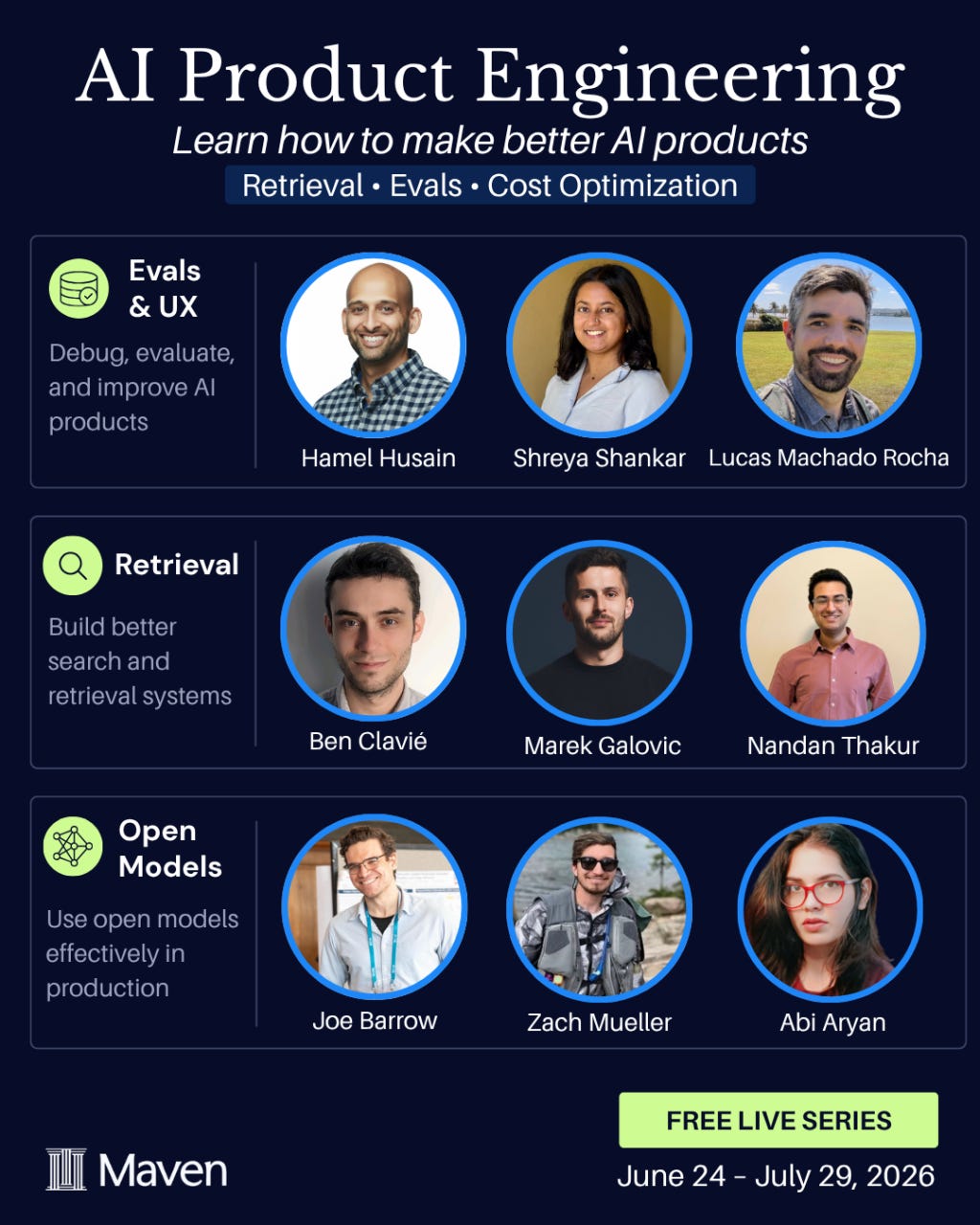
AI Product Engineering is nine free live sessions with Q&A, June 24 to July 29, taught by Hamel Husain, Shreya Shankar, Ben Clavié, and five others.
It starts tomorrow 👉 register free before the first session.
FAQ
How is AI product engineering different from AI engineering?
They overlap heavily. AI product engineering is the product-facing core of AI engineering: the work of making a model-powered feature reliable through retrieval, evals, inference tuning, and the loop from production failures back into fixes. You can do all of it without ever training a model.
What does an AI product engineer actually do?
Four jobs. They wire up retrieval so the model gets the right context, build evals and run error analysis to measure quality, tune the serving path so responses feel fast, and feed labeled production failures back into the next fix. The model comes off the shelf; the work is everything around it that decides whether the feature can be trusted.
Is AI product engineering a real job, or just a rebrand?
The label is new, the work is not. Teams have been doing retrieval, evals, and inference tuning under titles like AI engineer and ML engineer for years. What is new is that the work has consolidated into a teachable discipline with its own methods and its own courses, which is usually the sign a job category has arrived rather than a sign it is hype.
Which of these layers is eating most of your debugging time right now, retrieval, evals, or latency? Tell us in the comments.
A Field Guide to Rapidly Improving AI Products, Hamel Husain (March 2025)
Path to high-quality LLM-based Dasher support automation, DoorDash (April 2025)
A Field Guide to Rapidly Improving AI Products, Hamel Husain (March 2025)
Klarna again recruits humans for customer service, CX Dive (May 2025)
Your AI Product Needs Evals, Hamel Husain (March 2024)